Türkiye’deki oyuncular arasında popülerliğini artıran bahsegel güvenilir yapısıyla öne çıkıyor.
Türkiye’deki bahis severlerin ilk tercihi bahsegel olmaya devam ediyor.
Rulet masasında iç bahisler daha yüksek kazanç sağlar, bu seçenekler bahsegel giriş oyunlarında mevcuttur.
Oyuncular finansal işlemlerini koruma altına almak için pinco altyapısına büyük önem veriyor.
2024 yılında yapılan bir analiz, kullanıcıların %77’sinin mobil bildirim kampanyalarını değerlendirdiğini göstermiştir; bettilt giriş bu sistemi aktif kullanır.
Avrupa’da kullanıcıların %52’si en az bir kez canlı krupiyeli oyun deneyimi yaşamıştır; bettilt indir bu oran’te %70’e ulaşmaktadır.
En yeni casino oyunlarını deneyimlemek isteyenler için bettilt mükemmel bir platformdur.
Bahis dünyasında ortalama kullanıcı memnuniyeti %88 olarak kaydedilmiştir; pinco giriş bu oranı %93’e çıkarmıştır.
Statista 2026 verilerine göre dünya çapında online kumar oynayan kullanıcı sayısı 1.9 milyarı aşmıştır; bu eğilime Türkiye’de bettilt giriş öncülük etmektedir.
Mathematical Odds in Turbo Mines Game Explained
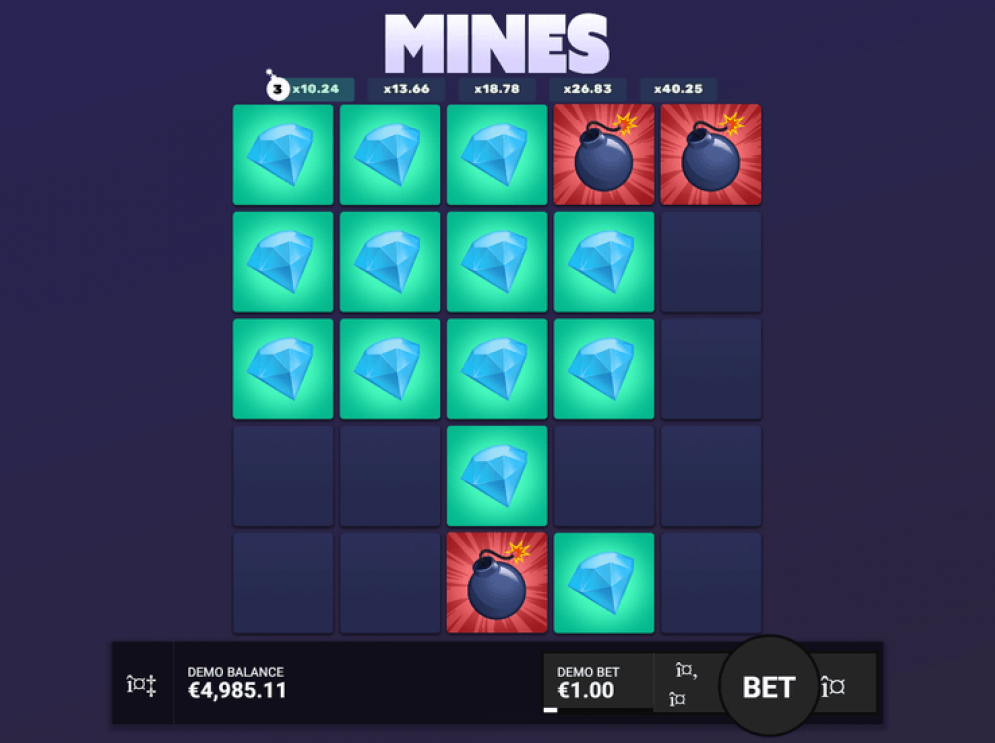
Anyone who examines chance-based games will consider Turbo Mines a fascinating subject. It’s a game that presents probability in easy clickable tiles. At its core, it’s a mathematical problem. Every move you do is a risk with evolving odds. Understanding those numbers doesn’t ruin the fun. It changes how you play. You quit guessing and commence making decisions. This article will explain the fundamental math that runs Turbo Mines. We’ll see how your chances change with each click and discuss ways to approach the grid in a smart way. The purpose is to give you the insight to see the game for what it is and to place your bets with more certainty.
Calculating Expected Value (EV) for Approach
Chance shows the likelihood of something occurring. Expected Value (EV) shows what that happening is priced at on mean over many, many rounds. In Turbo Mines, at any choice moment, the EV is determined by weighing the potential gain against the downside, adjusted by their chances. The equation is: EV = (Probability of Cashing Out * (Stake * Multiplier)) + (Probability of Hitting Mine * 0). Since striking a mine yields zero, that latter portion often disappears. A more valuable pre-game computation relates to the chance of attaining a specific multiplier level.
For instance, what’s the likelihood of successfully revealing 5 tiles in a line? In our standard case, it’s the result of each separate safe probability: (20/25) * (19/24) * (18/23) * (17/22) * (16/21). Compute it and you get about 0.20, a 20% chance. If the multiplier for 5 tiles is, for instance, 3x, then the EV for attempting to attain that level from the start is (Probability of Success * (3x Stake)). This is a streamlined representation. The true game’s payout framework has more intricacy. But the idea is key. A favorable EV implies a move that would be gainful over infinite iterations. Remember, each round is separate, and fluctuation can be unpredictable over a short stretch.
Why EV Alone Isn’t a Perfect Guide
Depending only on EV has shortcomings in a scenario like this. First, the calculation presumes you are aware of the exact multiplier increments, and these can vary. Second, and more significant, it overlooks your own comfort with danger and the amount of your bankroll. A strategy with a slight positive EV might force you through extended series where a one setback destroys your current bankroll. I view EV as a theoretical reference, not a rigid directive. It tells me if the game’s available multipliers are reasonably set against the probabilistic risk. That helps recognize times where acting more assertive or more cautious might make sense.
Tactical Methods Based on Odds
With the math as our foundation, we can discuss real strategies. The central strategic decision in Turbo Mines is when to cash out. Since risk grows with every tile, a conservative plan involves setting a low target multiplier and cashing out regularly. For instance, you might decide to always cash out after 3 safe tiles. This gives you a high probability of success on any single round, but your wins will be lower. An aggressive strategy targets higher multipliers, accepting the much lower chance of getting there.
- The Fixed Target Strategy: Choose a multiplier ahead of time, like 5x. Always cash out the instant you reach it, no matter how you feel. This forces consistency.
- The Percentage Risk Strategy: Determine a maximum acceptable risk percentage. Calculate how many safe tiles that represents. If you won’t accept more than a 30% failure chance, cash out at the point where the risk matches that mark.
- The Progressive Adjustment Strategy: Begin with a conservative target. After a successful cash-out, use some of the profit to finance a more aggressive try on the next round. This keeps your original bankroll safe.
No strategy eliminates risk. They only help you handle it. The trick is to choose one that matches your goals and then follow it. This avoids emotional decisions in the heat of the moment, which usually result in chasing losses or giving back winnings.
How Probability Shifts Per Click
The evolving odds are what make Turbo Mines so interesting to ponder. Any click that doesn’t conclude the game gives you perfect information. You know the exact number of tiles left and the unchanged count of mines left. Let’s extend our example. Say you’ve successfully opened 5 safe tiles. Now, 20 tiles remain, with 5 mines still buried. The chance your next click hits a mine is 5/20, or 25%. If you boldly open 10 safe tiles, 15 tiles are left with 5 mines. That yields the probability 5/15, or 33.33%. This progression isn’t linear in how it feels. The jump from 20% to 33% is a substantial rise in danger.
Mapping the Risk Curve
It helps to visualize this as a curve https://turbomines.net/. The risk commences at a fixed point, like 20%, and rises slowly at first. Then it gets steeper as the number of safe tiles decreases. Envision opening 15 safe tiles in our 5-mine, 25-tile scenario. Only 10 tiles would be left. The probability the next tile is a mine is now 5/10—a straight 50/50 coin flip. This is a major mental threshold. The reward might look very appealing here, but you’re literally gambling on a coin flip. Understanding this curve enables you to set personal risk limits before you even start playing. That’s a indication of a methodical strategy.
Contrasting Turbo Mines against Traditional Minesweeper
The analogy comes naturally, but the two games differ fundamentally in how they employ information and chance. Traditional Minesweeper is a puzzle of logical reasoning. Reveal a safe cell and it reveals a number telling you how many mines surround it. This gives you precise local data to logically figure out where mines must be. You only use probability as a last resort. Turbo Mines, conversely, is a challenge of statistical chance and risk control. You receive no positional hints. The only stats that are relevant are the aggregate numbers: starting cells, starting mines, and uncovered cells.
- Information Type: Traditional Minesweeper gives positional, deductive hints. Turbo Mines gives only aggregate statistical information.
- Application of Skill: Traditional Minesweeper benefits logical deduction and pattern recognition. Turbo Mines favors probability assessment and psychological steadiness.
- Determinism of Outcomes: In Traditional Minesweeper, a perfectly logical player can always win. In Turbo Mines, even a perfect mathematical player cannot secure a victory on any individual round. The randomness of the starting reveal after a cash-out decision makes it not feasible.
This distinction is vital. If you approach Turbo Mines as if it were a reasoning challenge, you’ll become annoyed. You must accept it for what it is: a progressive betting game where numbers shape your risks, but luck determines each round.
Comprehending the Main Game Mechanics
First, let’s become clear how Turbo Mines actually works. You view a grid of tiles. A certain number of mines are placed behind them. Your job is to tap tiles one in sequence without striking a mine. Every empty tile displays a multiplier that grows your potential win. You can withdraw anytime to claim that multiplier, or you can proceed. The big difference from classic Minesweeper is the absence of “number clues.” You receive no hints about adjacent mines. Each fresh safe tile is an isolated event based entirely on what’s still present in the pool: remaining tiles and mines. This configuration creates a clear probability problem. Your sole information is how several tiles you’ve opened and how several mines were positioned at the start.
Key Variables in Every Round
Every round of Turbo Mines begins with a handful of fixed numbers. The grid size, for example 5×5, provides 25 in total tiles. The number of mines is additionally determined from the outset—for instance, 5 mines in that 25-tile grid. From your initial click, these numbers commence to influence each other. Your beginning chance of striking a mine is just (Number of Mines) / (Total Tiles). But that chance shifts. It shifts with every safe uncovering because the pool of remaining tiles gets diminished. This is not a game of drawing with replacement. Each pick impacts the next, a textbook case of non-independent probability. Seeing these moving odds is the stage at which strategic play starts.
The Withdrawal Choice Moment
This is where strategy really matters. The game offers a increasing multiplier in your view, but the hazard increases at the same time. Not a single strategy can guarantee a profit. Each round is its unique isolated puzzle of risk and reward. You can compute the numerical expectation, but the result is consistently binary: you either cash out and win, or you hit a mine and sacrifice your stake. So, comprehending the mechanics boils down to navigating that push and pull between greed and caution. Your compass through that tension is the group of objective numbers that define your chances at every single step.
The function of RNG and fair gaming
Any thoughtful player will ask: “Are the results truly random?” In digital games like Turbo Mines, outcomes come from a Random Number Generator (RNG). A correctly designed and audited RNG makes sure each tile’s status as a mine or safe is chosen randomly when the round starts. There’s no pattern to predict. This is the cornerstone of fair play. For you, it means the probability calculations we’re talking about are valid models of how the game behaves. “Hot streaks” or being “due for a loss” are not real. The odds for each click are determined purely by the remaining tiles and mines at that exact instant.
Understanding the RNG drives everything strengthens using probability-based strategy over superstition. You can’t outsmart a genuinely random sequence. Your edge comes from directing your decisions inside the known statistical framework. Reputable gaming platforms use provably fair systems where you can verify the randomness. As a player, knowing the game uses a certified RNG lets you trust the math you apply. It shifts your mindset from hoping for luck to executing a plan based on calculable risk. That’s a stronger, more satisfying way to play.
Useful Advice for Putting This Knowledge into Practice
So how do you apply all this theory to the virtual grid? First, always examine the game settings at the start: grid size and mine count. Do the quick mental math for the starting risk (mines divided by tiles). Second, decide your strategy before your first click. Are you going for small, frequent wins, or shooting for a high multiplier? Set a clear cash-out point based on a tile count or a risk percentage. Third, handle your bankroll without mercy. Never bet more on one round than you’re willing to lose. Even a 95% safe chance still fails 1 in 20 times.
- Start Small: Use the smallest allowed stake to test the multiplier steps and notice how you react emotionally to the rising risk.
- Use a Probability Cheat Sheet: Keep a basic table handy. For a common setup like 5 mines in 25 tiles, recall: after 5 safe tiles, risk is 25%; after 10, it’s 33%; after 15, it’s 50%.
- Practice Disciplined Exits: When your pre-set target is hit, withdraw. Right then. Don’t allow the next multiplier tempt you. The mathematical jump in risk is rarely worth the extra reward.
- Review Sessions: Analyze your play not in terms of wins and losses, but on whether you stuck to your planned strategy. This builds discipline for the long run.
The goal of understanding the math is not about “beating” the game in a surefire way. It’s to make informed choices, control what you expect to happen, and appreciate engaging with a well-designed system of chance. When you frame each click as a probability calculation, you shift your play from reactive to proactive. That’s what a smart player does.
Frequent Fallacies About Odds in Mines Games
A few stubborn myths may wreak havoc with a gambler’s judgment. The main is the “Gambler’s Fallacy”: the idea that after a string of safe tiles, a mine is “due”. This couldn’t be more inaccurate. If you are left with 10 tiles holding 3 mines, the probability for the next tile remains 3/10 (30%). It doesn’t matter what occurred during the previous 15 tiles. The past has no effect on the independent random event of the next click. An additional erroneous belief suggests particular tile positions provide better odds. On a grid featuring a truly random mine placement, every unclicked tile has exactly the same probability of concealing a mine, given the current remaining mine count.
The Illusion of Control
Players frequently adopt rituals or patterns, such as always starting from a corner, imagining it alters their luck. This represents an illusion of control. While you select which specific tile to click first, the mine layout was set randomly ahead of that click. Clicking the top-left tile instead of the center tile doesn’t alter the overall starting probability for that click. Understanding and disregarding these misconceptions is essential for clear, math-based thinking. It discourages you from making choices based on imaginary patterns and keeps your focus upon the variables you can actually control: your cash-out point and your stake size.
The Simple Math of Starting Probability
Let’s begin with the most basic part. Imagine beginning a game on a 5×5 grid with 5 mines. On your first click, with all tiles untouched, you have 25 choices. Five of them are mines. Your probability of hitting a mine right away is 5/25. That breaks down to 1/5, or 20%. Your odds of picking a safe tile is 20/25, or 80%. This is basic arithmetic. The multiplier value shown on that first safe tile is set by the game’s own model. It isn’t a direct result of this probability. Maintain the idea of survival chance separate from the reward multiplier. They’re linked in terms of risk, but the game determines them independently.
This first probability is the only time the math remains this straightforward. Once you expose a safe tile, everything changes. You now have 24 tiles left, but the number of mines is still 5 (assuming you didn’t hit one). The new probability of hitting a mine on your next click becomes 5/24. That’s about 20.83%. The chance of safety is 19/24, roughly 79.17%. Observe the risk has gone up, just a little. This small uptick in danger continues with every safe click. This is the core mathematical rule of Turbo Mines: with every safe step forward, the path behind you vanishes, and the path ahead gets statistically more dangerous.